
Country guide — Asia-Pacific
 Expat insurance and health insurance in Tokelau
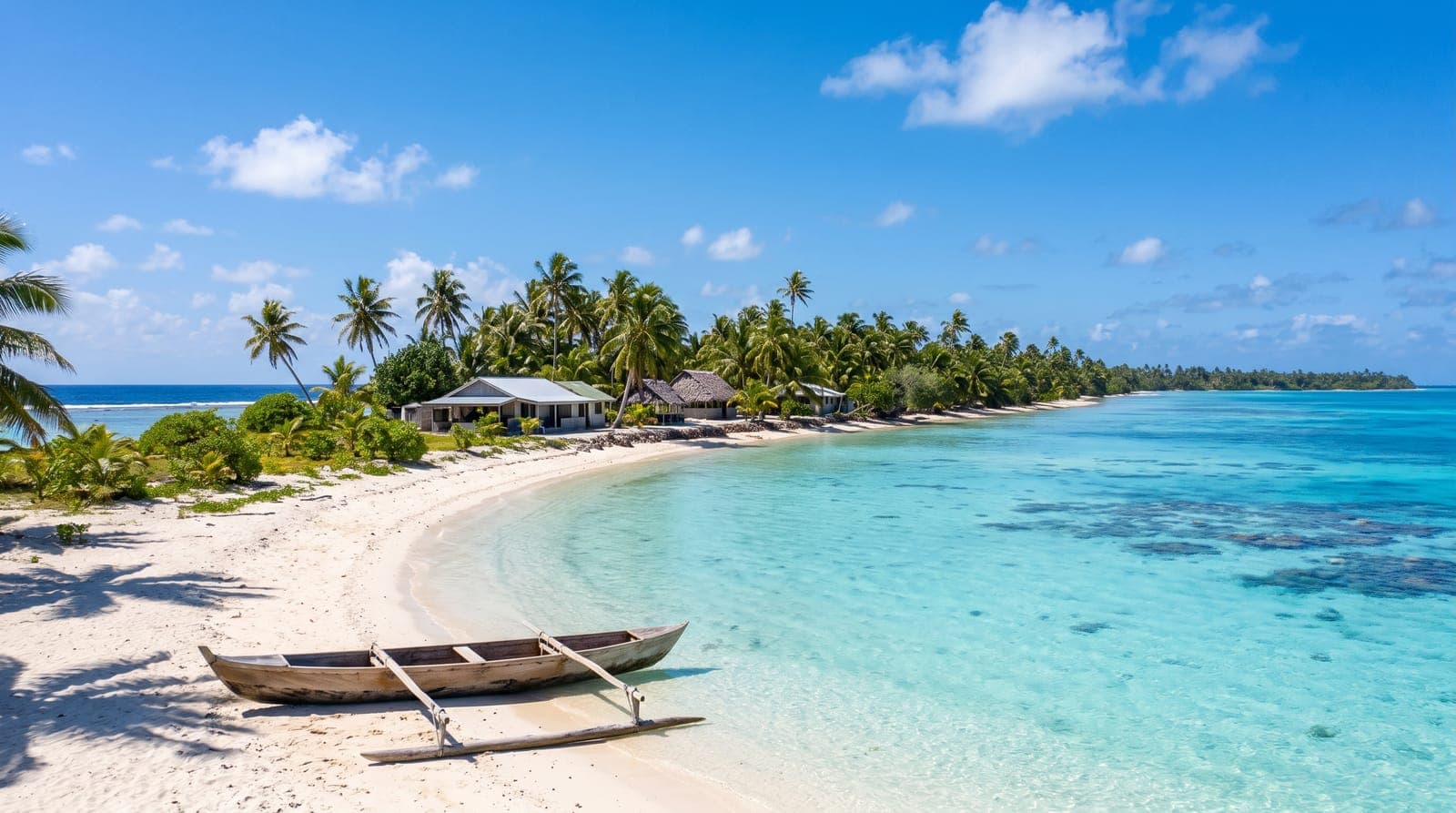
In short
Tokelau is a non-self-governing territory within the Realm of New Zealand (New Zealand Ministry of Foreign Affairs and Trade), made up of three atolls, Atafu, Nukunonu and Fakaofo, about 500 km north of Samoa. It has no airport: you get there by boat from Apia, in 24 to 30 hours depending on the atoll, and the official brochure of the Government of Tokelau requires non-Tokelauans to apply for a permit before entering; France Diplomatie publishes no entry rule specific to Tokelau and places the territory under the responsibility of the French embassy in Wellington. No social security agreement links France to Tokelau or to New Zealand (CLEISS): the carte Vitale reimburses no care on site, an employee on a local contract falls under the local scheme, a seconded employee keeps the French scheme on the basis of domestic law, for 3 years renewable once. Care rests on three public hospitals, one per atoll, which mainly provide primary care according to the independent evaluation published by New Zealand's MFAT; serious cases are referred to Apia or New Zealand through a patient referral scheme open to residents, people resident for more than six months, locums and government contractors, in which visitors do not appear. An assistance contract covering medical costs and medical repatriation is therefore essential (France Diplomatie; Tokelau Department of Health). The BOFiP list of tax treaties includes New Zealand (30 November 1979) but not Tokelau: the territorial scope should be checked before any departure. The lasting risks are isolation, cyclones, drought, exceptional tides and rising seas on atolls 3 to 5 metres above sea level.
Service being launched: an advisor reviews your request and gets back to you to clarify your needs.
Everything about Tokelau
- Living there →Pros and cons, cities, cost of living, housing, settling in.
- Work and economy →Jobs for foreigners, work permits, salaries, the economy.
- Healthcare system →Public and private care, hospitals, local health insurance, access to care.
- Medical reimbursements →Who pays for what, by situation: employee, self-employed, retiree, student.
- Retiring there →Visa, pension taxation, healthcare for retirees, S1 form, cost of living.

Key figures
- Three atolls (Atafu, Nukunonu, Fakaofo), 3 to 5 metres above sea level and about 500 km north of Samoa (Government of Tokelau).
- Access by boat only from Apia: about 24 hours to Fakaofo, 26 to Nukunonu and 30 to Atafu (Tokelau Department of Transport brochure).
- Social security agreement with France: none; neither Tokelau nor New Zealand appears in CLEISS's list of bilateral agreements in force.
- Currency: the New Zealand dollar is the only currency used in Tokelau (Government of Tokelau, visitor FAQs).
- Consular register: no number of French nationals registered specifically for Tokelau was identified in the official sources consulted; the French embassy in Wellington is responsible.

Local healthcare system
Tokelau has no contribution-based health insurance scheme comparable to French Sécurité sociale. Care is organised by the Tokelau Government's Department of Health, whose director is based in Apia, and relies on three public hospitals, one per atoll. The independent evaluation of health services published by New Zealand's MFAT specifies that they mainly deliver primary care: St Joseph's Hospital in Nukunonu was developed as the national referral hospital, run directly by the Department of Health, while the services of Fakaofo and Atafu are run by their village councils (Taupulega). Cases the atolls cannot treat are referred to the hospital in Apia, in Samoa, or to New Zealand under the Tokelau patient referral scheme.
This scheme is open to Tokelauans living on the atolls and, according to the policy cited by the MFAT evaluation, to people who have lived there for more than six months, medical locums and government contractors; a visitor is not cited among the beneficiaries. New Zealand citizens, including those of Tokelau, have access to New Zealand's publicly funded services (Health New Zealand); a French national is entitled to them only under the visa conditions set by that country. France Diplomatie deems an assistance contract or insurance covering all medical costs and medical repatriation imperative, and Tokelau's Department of Health advises travellers to take out travel insurance, as cyclones, medical evacuations and changes to the boat schedule can disrupt a stay. See the page healthcare system in Tokelau.

Legal and visa obligations
- Entry permit: the official brochure of Tokelau's Department of Transport and Support Services states that non-Tokelauans must apply for a permit to enter; applications go through the immigration officer at the Savalalo office, in Apia. France Diplomatie publishes no entry rule specific to Tokelau: whether a permit can be obtained, its duration and its cost should be confirmed with the Government of Tokelau before any booking.
- Transit through Apia: the only access is through Samoa, where a French national needs no visa for up to 90 days in 180, with a passport valid for at least 6 months after the planned end of stay and proof of onward departure from the territory (France Diplomatie, Samoa sheet).
- Travel insurance: an assistance contract covering medical costs and medical repatriation is deemed imperative by France Diplomatie; the French embassy never covers these costs. Tokelau's Department of Health and the boat brochure also recommend personal insurance.
- Health before departure: bring your medication for the whole stay and a clinical summary, as well as repellent, plasters and hygiene products, which travellers are responsible for (Tokelau Department of Health); in Apia, drink bottled or boiled water, as typhoid is reported in drinking water in Samoa.
- Local affiliation: no health insurance obligation for a visitor was found in the sources consulted, and no contribution-based health insurance fund is described there.
- Student: no EHIC, as Tokelau is not a member of the European Union; no local student scheme is described, so student insurance abroad or the CFE should be compared before departure.
- Seconded employee : without an agreement, continuation of the French scheme on the basis of domestic law, for 3 years renewable once (CLEISS); the CFE and an assistance contract remain recommended in addition.
- Retiree: no S1 form; CLEISS invites retirees to check the existing cover with local institutions, then to choose between the CFE and private insurance.
No individual fine for lacking insurance is mentioned in the sources consulted, but the fact that visitors are not covered by the patient referral scheme, the distance from Apia and the cost of an evacuation make the financial risk high for an uninsured expat.

Cost of some medical procedures
Indicative benchmarks, not an official fee schedule: prices vary by provider, so ask for a quote before treatment.
| Procedure | Public sector | Private sector |
|---|---|---|
| Care in the atolls' public hospitals | No published fee schedule was found in the sources read; ask Tokelau's Department of Health before departure | — |
| Medical transfer to Apia or New Zealand (patient referral scheme) | Funded for scheme beneficiaries (residents, people resident for more than six months, locums and government contractors, according to the MFAT evaluation); a visitor does not appear: evacuation to be covered by an assistance contract | — |
| Boat crossing from Apia | Fares set by the Department of Transport and Support Services, different for Tokelauans and other travellers; consult the official brochure in force | — |
| Care in New Zealand for a non-citizen | Publicly funded services reserved for citizens, residents and certain work visa holders; other people pay for their care (Health New Zealand) | — |
| Unplanned care during a temporary stay, French reimbursement | Possible reimbursement on return based on French flat-rate tariffs, at the discretion of the medical adviser (Assurance Maladie) | — |
| CFE membership | — | CFE plans depending on age and profile (youth, main, retirees), price on quotation (cfe.fr) |

Social security agreements with France
According to the New Zealand Ministry of Foreign Affairs and Trade, Tokelau is a non-self-governing territory within the Realm of New Zealand, with its own political institutions, judicial system and public services. An Administrator, a New Zealand government official, heads the executive under the authority of the New Zealand Minister of Foreign Affairs; powers are delegated to the village councils (Taupulega) of the three atolls, and the General Fono (national assembly) deals with national matters. New Zealand retains responsibility for international obligations, defence and security. The inhabitants of Tokelau are New Zealand citizens. It is neither a French territory nor an ordinary New Zealand province: the rules on entry, health and employment are those of the Government of Tokelau, and it is the embassy in Wellington that is responsible for the territory for France.
- Social security: CLEISS indicates that France has signed no bilateral social security agreement with New Zealand, and the list of agreements in force includes neither New Zealand nor Tokelau. There is therefore no coordination of schemes: no S1 form, no EHIC, no cross-border cover (see the bilateral agreement). The French-New Zealand working holiday agreement creates no right to care: a young person on a working holiday visa is not eligible for the host country's health insurance (CLEISS), and no programme of this kind is described for Tokelau.
- Employee on a local contract: the expatriate is subject to the scheme of the country of work and is no longer insured in France; they hand back their carte Vitale and may contribute voluntarily to the CFE (CLEISS).
- Secondment: without an agreement, the employer may keep its employee in the French scheme for 3 years renewable once, with a 2-year waiting period before a new secondment in the same country; care is covered within the limit of French benefits, on paid invoices sent with form S 3125c (CLEISS). The formalities go through Urssaf (international mobility department).
- Retiree: health insurance contribution of 3.2% (basic pension) and 4.2% (supplementary pension) as a general rule, as long as they fall under a French scheme; no CSG, CRDS or Casa if tax residence is no longer in France (CLEISS).
Tax treaty. The BOFiP list of tax treaties concluded by France includes New Zealand (treaty of 30 November 1979, in force since 19 March 1981) but no entry for Tokelau, and Tokelau does not appear either in the BOFiP list of tax information exchange agreements. The text of article 3 of the New Zealand treaty, which defines its territorial scope, could not be read on impots.gouv.fr: the application of this treaty to Tokelau should therefore not be presumed, and should be checked in the text of the treaty before reasoning by analogy. A French national remains taxable in France on all of their income as long as they have their tax domicile there, that is, their home or main place of stay, their main professional activity or the centre of their economic interests (article 4 B of the French general tax code, BOFiP). The income tax regime applying in Tokelau was not found in the sources read.

Which insurance for my profile
General matrix — does not recommend any specific product or insurer.
| Profile | Regulatory constraint | Points of attention |
|---|---|---|
| Working holiday visa | The French-New Zealand working holiday programme does not cover Tokelau in the sources read; entry of any non-Tokelauan requires a permit | A young person on a working holiday visa is not eligible for local health insurance (CLEISS): comprehensive insurance essential |
| Student | No higher education establishment or student scheme is described; no EHIC; student insurance or CFE to compare | Under 20 or under 6 months: urgent care paid up front then possibly reimbursed by the parents' fund (Assurance Maladie) |
| Seconded employee | French scheme maintained for 3 years renewable once (domestic law); costs reimbursed on paid invoices (S 3125c), within the limit of French benefits | Limited care on site: evacuation and costs outside France to be covered by top-up insurance or a group contract |
| Local employee / settled resident | Local contract under Tokelau's rules; leaves the French scheme; permit required; patient referral scheme open to residents of more than six months | No coordination with France: CFE or private insurance to arrange from arrival |
| Self-employed / freelancer | No self-employment rule read in the sources; entry permit required; no sickness coordination with France | CFE, international insurance or an individual contract to arrange before departure |
| Retiree | No retiree residence category described; permit required; no S1 form; CFE (retirees' plan) or private insurance with evacuation | Primary care only on the atolls: management of chronic illnesses to be checked |

Hospitals and care network
- Fakaofo: Fenuafala hospital (Tai) and a clinic at Fale, services run by the Fakaofo village council (Taupulega).
- Nukunonu: St Joseph's Hospital, at Motuhaga, developed as the national referral hospital and run directly by Tokelau's Department of Health.
- Atafu: Lomaloma Hospital, a service run by the Atafu village council (Taupulega).

Practical steps
- Before departure: notify French agencies of your departure (health insurance fund, CAF, France Travail, pension funds); hand back your carte Vitale if you are expatriating.
- For any stay, including a short one: take out an assistance contract or insurance covering all medical costs, evacuation and medical repatriation, imperative according to France Diplomatie.
- Contact Tokelau's Department of Transport and Support Services, in Apia, to find out whether an entry permit can be issued, then book the crossing; book no ticket or accommodation before having the permit.
- Plan entry to Samoa (no visa for up to 90 days in 180 for a French national, passport valid 6 months after the end of the stay, proof of onward departure) and private accommodation with a host family or in the villages' guesthouses.
- Bring your medication for the whole length of the stay, a clinical summary, repellent and plasters; bring your health forms to the department on arrival in Apia, as a check is planned on departure and arrival (Tokelau Department of Health).
- Seconded employee: request continuation of the French scheme from Urssaf (international mobility department) before departure; then send paid invoices with form S 3125c.
- Long-term settlement: choose health protection (employer's contract, individual contract or CFE), before departure or within the deadlines indicated by the CFE.
- Taxation: have your situation validated with the French tax administration and Tokelau's administration; read article 3 of the French-New Zealand treaty before assuming it applies.
- Retiree: contact CLEISS or your pension fund before departure, then compare the CFE (retirees' plan) and private insurance.
- Register on the roll of French nationals living abroad with the French embassy in Wellington, responsible for Tokelau (free).

Frequently asked questions
Is Tokelau part of New Zealand?
Tokelau is a non-self-governing territory within the Realm of New Zealand, according to the New Zealand Ministry of Foreign Affairs and Trade. It has its own political institutions, judicial system and public services; its inhabitants are New Zealand citizens, and New Zealand retains responsibility for defence, security and international obligations.
Do I need a visa or a permit to go to Tokelau?
The official brochure of Tokelau's Department of Transport and Support Services states that non-Tokelauans must apply for a permit to enter, through the immigration officer at the Apia office. France Diplomatie publishes no rule specific to Tokelau: it should be confirmed with the Government of Tokelau that a permit can be issued before any booking.
How do you get to Tokelau?
Tokelau has no airport. Passengers take a boat from Apia, in Samoa: about 24 hours to Fakaofo, 26 to Nukunonu and 30 to Atafu according to the official brochure. The passenger vessel leaves at regular intervals but its schedule can change, notably during medical evacuations.
Is there a social security agreement between France and Tokelau?
No. CLEISS indicates that France has signed no bilateral social security agreement with New Zealand, and neither New Zealand nor Tokelau appears in the list of agreements in force. The carte Vitale and the EHIC do not apply: an employee on a local contract falls under the local scheme, a seconded employee keeps the French scheme for 3 years renewable once, and other profiles choose between the CFE and private insurance.
Is there a tax treaty between France and Tokelau?
The BOFiP list of tax treaties includes New Zealand but not Tokelau, and Tokelau does not appear in the list of tax information exchange agreements. The application of the New Zealand treaty to Tokelau depends on the definition of its territorial scope in article 3: it is not presumed and should be checked in the text.
Where is care provided in Tokelau and what happens in a serious case?
Each atoll has a public hospital that mainly provides primary care. Serious cases are referred to Apia or New Zealand through the patient referral scheme, which benefits residents, people resident for more than six months, locums and government contractors, but does not cite visitors. France Diplomatie deems an assistance contract covering medical costs and medical repatriation imperative.
What are the main natural risks?
The Government of Tokelau identifies cyclones, storms, drought, flooding linked to exceptional tides and storm surges, sea level rise and tsunamis. The atolls rise to 3 to 5 metres above sea level, and the wet season runs from November to April. Guidance is obtained from Tokelau's authorities at the time of the stay.
Moving to Tokelau? Request a personalised study