
Country guide — Americas
 Social security and health insurance in Martinique
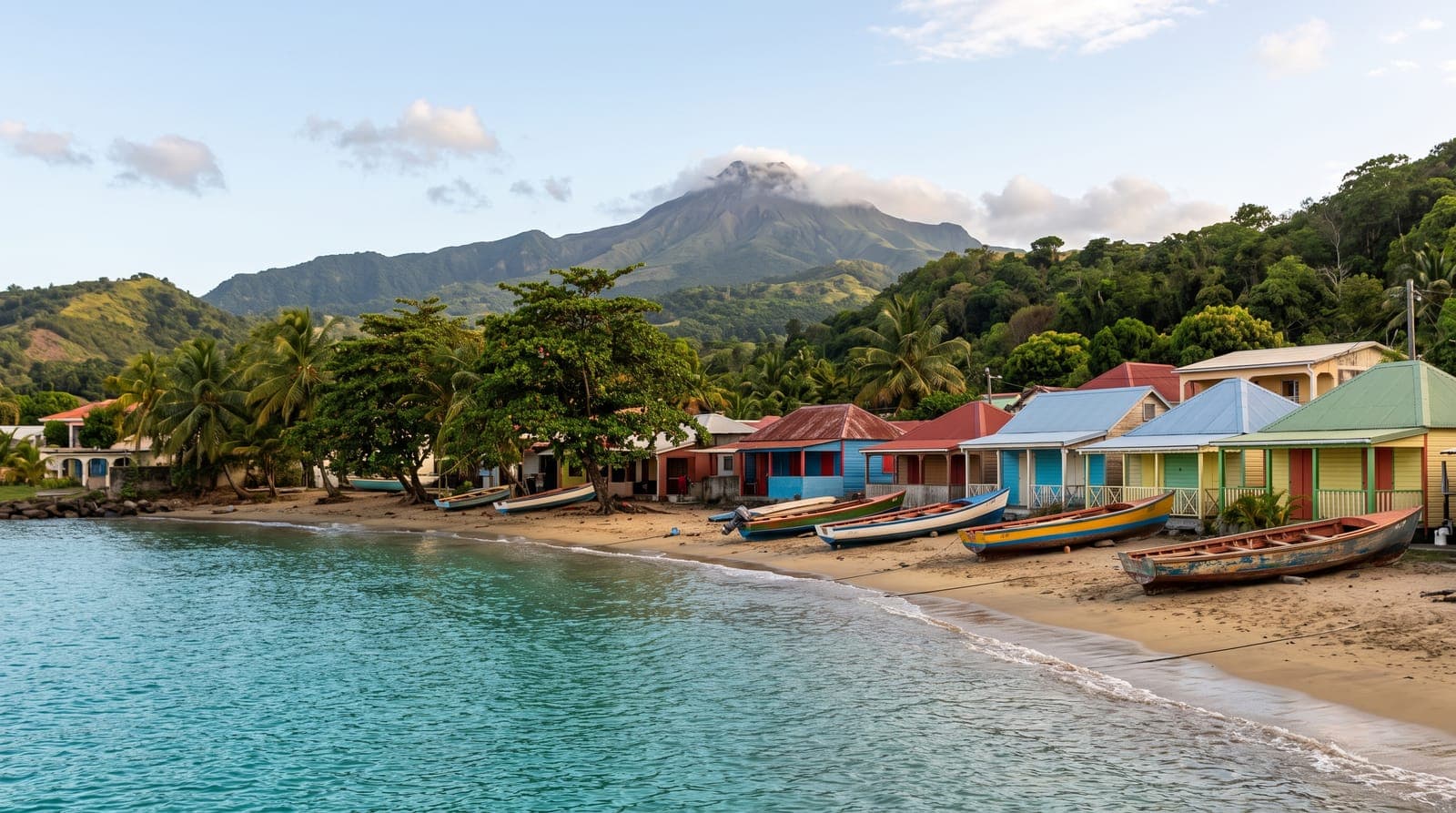
In short
Martinique is not a foreign country: it is an overseas department and region governed by Article 73 of the Constitution, administered by a single territorial authority, the Collectivité territoriale de Martinique (CTM), whose first elections took place in December 2015 (IEDOM, the overseas issuing institute). Standard social security applies there: Title V of Book VII of the Social Security Code expressly covers Martinique, and it is the Caisse Générale de Sécurité Sociale (CGSS, the general social security fund) of Martinique, not a CPAM, that pays benefits. A French citizen moving there from mainland France therefore remains covered by the scheme they come under (employee, civil servant, self-employed, person with no occupation), with the Vitale card, the national reimbursement rates and the Complémentaire Santé Solidaire, for which the public service publishes ceilings specific to the overseas departments; the Caisse des Français de l'Étranger (CFE, the French overseas nationals' health fund) only becomes useful if you leave France. Care that cannot be provided on the island gives rise to a medical transfer or evacuation, covered subject to prior approval by the Assurance Maladie (French national health insurance). The status may change: a framework agreement opens discussions on autonomous rule-making power, with consultation of voters, without by itself changing the current scheme.
Service being launched: an advisor reviews your request and gets back to you to clarify your needs.
Everything about Martinique
- Living there →Pros and cons, cities, cost of living, housing, settling in.
- Work and economy →Jobs for foreigners, work permits, salaries, the economy.
- Healthcare system →Public and private care, hospitals, local health insurance, access to care.
- Medical reimbursements →Who pays for what, by situation: employee, self-employed, retiree, student.
- Retiring there →Visa, pension taxation, healthcare for retirees, S1 form, cost of living.

Key figures
- About 360,000 inhabitants (Insee estimate cited by IEDOM), in continuous decline for several years; more than a third of inhabitants are over 60, which makes Martinique the oldest region in France.
- Applicable scheme: standard social security (Article L. 751-1 of the Social Security Code); a CGSS and a family allowance fund specific to Martinique (Article L. 752-1).
- Hospital provision: 14 public facilities (including 5 regional or university hospital centres and 8 hospital centres) and 4 private facilities; 3 facilities have a maternity unit (ARS and STATISS, cited by IEDOM).
- Number of French nationals on the consular register: not applicable, as Martinique is part of the territory of the Republic.

Local healthcare system
Martinique is an overseas department and region governed by Article 73 of the Constitution. Following the referendums of January 2010, the laws of 27 July 2011 created a single territorial authority, the Collectivité territoriale de Martinique (CTM), which exercises the powers of both department and region; its first elections date from December 2015 (IEDOM). The General Code of Territorial Authorities (Article L. 7251-1) allows it to promote the economic, social and health development of the island, but does not give it a social protection scheme of its own: general social security legislation applies in Martinique (Article L. 751-1 of the Social Security Code).
On the ground, the CGSS of Martinique (Lamentin) brings together health insurance, pension insurance, the Urssaf (the social security contributions collection body) for employers and the self-employed, and the occupational risks branch; the family allowance fund manages family benefits and housing aid. CLEISS (the French centre for European and international social security liaison) recalls that, in the overseas departments, benefits are paid by the CGSS and not by the CPAM. The Regional Health Agency (ARS) of Martinique steers the care offering, prevention and health monitoring under the 2023-2028 regional health project.
Provision is dominated by the public sector: the Martinique University Hospital (CHU), a public teaching and research facility based in Fort-de-France, hospital centres and a mental health facility, according to IEDOM. The territory is ageing rapidly, with a high prevalence of chronic diseases (hypertension markedly more frequent than in mainland France) and a shortfall in accommodation for older people; hospital reconstructions funded by the Ségur plan are under way, notably the Saint-Esprit hospital complex.
Change of status. In October 2025, the Congress of elected officials and the Assembly of Martinique came out in favour of an autonomous rule-making power. A framework agreement between the State and the authority, published in the Journal officiel, opens discussions on an institutional reform proposal (health is among the areas mentioned) and provides that its implementation will be subject to a consultation of voters. This text sets out a method and does not by itself change the social protection scheme described here.

Legal and visa obligations
- Entry and stay: Martinique is part of the Republic; a French citizen arriving from mainland France has no visa or residence permit to apply for. The formalities are those of a move within France (change of address, fund, tax declarations). Nationals of other countries should enquire with the prefecture (section "Foreign nationals in Martinique").
- Conditions for opening rights: according to the Assurance Maladie, anyone who works or lives in France on a stable and lawful basis is entitled to have their healthcare costs covered. An employee has no minimum period of activity to show; a self-employed person is covered from the start of their activity; a person with no occupation is covered on the basis of their residence. During an inspection, the Assurance Maladie asks for proof of 6 months of residence in France over the last 12 months; CLEISS for its part mentions residence of at least 3 months. See also the definition of universal health coverage (PUMa).
- Competent fund: the CGSS of Martinique. In certain cases (arrival in France, residence alone, change of situation), the opening of rights is not automatic: CLEISS indicates that Cerfa form S1106 must then be filled in and sent to the body of the place of residence.
- Civil servant transferred to Martinique: they keep the scheme of their branch of the civil service; the handling of their health insurance file and the pay supplement should be confirmed with their administration (the concept of secondment abroad has no meaning for a post in Martinique).
- Student: according to the public service, the student generally keeps their compulsory scheme, often their parents', becomes an independent insured person at 18 and can ask to be one from age 16. Student insurance for abroad does not apply to this French territory.
- Supplementary health cover: the co-payment (ticket modérateur), the daily hospital charge and extra-billing fall to supplementary cover. The Complémentaire Santé Solidaire (C2S, supplementary solidarity health cover) is free up to a ceiling of annual income, revised each year, for a single person in the overseas departments (Guadeloupe, French Guiana, Martinique, Réunion), and with a financial contribution up to a second ceiling (service-public.gouv.fr).
- Departure outside France: only a departure from Martinique to a foreign country comes under the logic of expatriation. The public service indicates that an expatriate can join the Caisse des Français de l'Étranger (CFE) to keep the French scheme; its offers are the main offer, the youth offer and the retiree offer.
The sources consulted mention no fine specific to the territory for lacking cover. The practical point is to declare your situation to the CGSS on arrival so that rights are open before the first care.

Cost of some medical procedures
Indicative benchmarks, not an official fee schedule: prices vary by provider, so ask for a quote before treatment.
| Procedure | Public sector | Private sector |
|---|---|---|
| General practitioner consultation | Reimbursed at 70% of the €30 base; €2 flat-rate contribution withheld from the reimbursed share (Assurance Maladie, CLEISS) | Extra-billing possible outside sector 1; rates not published in the sources consulted |
| Hospitalisation | Covered at 80%; daily hospital charge of €23 (CLEISS), covered by supplementary cover or the C2S | — |
| Emergency room visit | Emergency patient charge payable, reduced for some insured people; amount revised regularly (CLEISS) | — |
| Medicines | Reimbursed at 65% (major or important medical benefit), 30%, 15% or 100% depending on the medicine; €1 medical deductible per box (Assurance Maladie) | — |
| Dental care and optical | Dental surgeon consultation and optical reimbursed at 60% of the reimbursement base; specific packages with the C2S | Extra-billing possible; rates not published in the sources consulted |
| Medical transfer or evacuation from Martinique | Transport covered subject to prior approval equivalent to a medical prescription; medical costs reimbursed in part or in full if the exemption conditions are met; companion under conditions (Assurance Maladie) | No rate published on the page consulted |
| Complémentaire Santé Solidaire (single person) | Free under an annual income ceiling, revised each year; with contribution up to a second ceiling (service-public.gouv.fr) | — |

Social security agreements with France
There is neither a social security agreement nor a coordination regulation between mainland France and Martinique, since the island is part of the Republic. The framework is institutional:
- Status: overseas department and region (Article 73 of the Constitution), run by the Collectivité territoriale de Martinique; national law applies with authorised adaptations (IEDOM). Martinique is also an outermost region of the European Union.
- Social security: general legislation applies in Martinique (Article L. 751-1); the CGSS and the family allowance fund of Martinique are established by Article L. 752-1.
- Moving from one French territory to another: no coordination form; the Assurance Maladie treats health-related travel from the overseas departments, including Martinique, separately. It specifies that French Polynesia, New Caledonia, Saint-Pierre-et-Miquelon and Wallis and Futuna are not covered, which sets them apart from Martinique.
- Institutional reform under discussion: the framework agreement published in the Journal officiel provides for a negotiating group and a consultation of voters before any implementation; it has no bearing on health insurance by itself.
- For a stay outside France (neighbouring Caribbean, North America): the rules on "care abroad" and an assistance and repatriation policy should be prepared in advance.

Which insurance for my profile
General matrix — does not recommend any specific product or insurer.
| Profile | Regulatory constraint | Points of attention |
|---|---|---|
| Working holiday visa | Not applicable to a French national: no working holiday programme, Martinique coming under French law | — |
| Student | Compulsory scheme generally kept (often the parents'), independent insured person at 18 or from 16 on request | Student insurance abroad not applicable; C2S possible subject to means |
| Employee from mainland France | Rights opened by carrying out the activity, no minimum duration; fund: CGSS of Martinique | Supplementary health cover useful for the co-payment and extra-billing |
| Transferred civil servant | Scheme of their branch of the civil service; manager to be confirmed with their administration | Pay supplement and bonified leave to be checked with the managing department |
| Self-employed / freelancer | Rights open from the start of the activity; Urssaf for the self-employed via the CGSS | Contribution terms to be confirmed with the CGSS |
| Retiree | Covered on the basis of stable and lawful residence; form S1106 if opening is not automatic | Pension: notify your pension fund of the change of address |
| No occupation, resident | Rights on a residence criterion (Cerfa S1106), possible inspection of 6 months out of 12 of residence | 30-day response period if proof of residence is requested |
| Departure abroad | Membership of the CFE possible (main, youth or retiree offer) if residence is transferred outside France | Not useful as long as you live in Martinique |

Hospitals and care network
- Martinique University Hospital (CHU): public teaching and research facility in Fort-de-France (Pierre Zobda-Quitman hospital); switchboard 05 96 55 20 00, adult emergencies 05 96 55 20 00, paediatric emergencies 05 96 55 11 82, SAMU 15; the CHU presents 7 hospitals and a project to rebuild the Louis Domergue hospital in La Trinité.
- Saint-Esprit hospital complex: reconstruction under way as part of the Ségur plan (hospital and nursing home) (IEDOM).
- Public provision: 5 regional or university hospital centres, 8 hospital centres and 1 mental health facility (ARS and STATISS, cited by IEDOM).
- National emergency numbers (Ministry of the Interior): 15 SAMU, 17 police emergency, 18 fire brigade, 112 European number, 114 for deaf or hard-of-hearing people, 196 sea rescue, 3114 suicide prevention.

Practical steps
- Before leaving mainland France: report your change of address and situation to your Assurance Maladie fund, the family allowance fund, France Travail and your pension fund.
- Employee: carrying out the activity opens rights; confirm with the employer and the CGSS of Martinique that the file is attached. Civil servant: contact the managing department for the transfer of the file and the pay supplement.
- With no professional activity or if opening is not automatic: submit Cerfa form S1106 with supporting documents to the CGSS of Martinique (Rue Case Nègres, Place d'Armes, 97 210 Lamentin Cedex 2, address given by the CGSS for sending documents).
- Keep proof of residence: the Assurance Maladie may ask for proof of 6 months of residence over the last 12 months, with 30 days to reply.
- Create or update your ameli account and have your Vitale card checked; choose a GP of record (médecin traitant) locally.
- Assess your supplementary health cover needs, or your rights to the C2S using the Assurance Maladie simulator, according to the overseas departments' ceilings.
- For care that cannot be provided on the island: ask your doctor for prior approval for transport, then contact your fund's referent (or the PASS, the hospital healthcare access service, during a hospital stay) and consult the health-related travel passport; an assistance policy can supplement cover for costs not covered.
- For a return to mainland France: inform the CGSS and request the opening of rights with the fund of your new place of residence (S1106 if it is not automatic); see also the guide return to France.

Frequently asked questions
Is Martinique a foreign country for health insurance?
No. It is an overseas department and region governed by Article 73 of the Constitution, administered by the Collectivité territoriale de Martinique. Title V of Book VII of the Social Security Code applies there: there is no social security agreement and no expatriation formality to live on the island.
Which fund replaces the CPAM in Martinique?
The Caisse Générale de Sécurité Sociale (CGSS) of Martinique. CLEISS specifies that, in the overseas departments, benefits are paid by the CGSS and not by the CPAM; the family allowance fund of Martinique manages family benefits.
Is Martinique's status changing?
Discussions are open: a framework agreement between the State and the authority envisages an autonomous rule-making power and provides for a consultation of voters before any implementation. It sets out a method and does not by itself change the social protection scheme.
Does the Complémentaire Santé Solidaire exist in Martinique?
Yes. For Guadeloupe, French Guiana, Martinique and Réunion, the public service publishes ceilings of annual income, revised each year, for a single person for free C2S and with a financial contribution.
What happens if care is not available on the island?
The patient can benefit from a medical transfer (from their home) or a medical evacuation (from their place of hospitalisation). According to the Assurance Maladie, transport is covered subject to prior approval equivalent to a medical prescription, and medical costs are reimbursed in part or in full if the exemption conditions are met.
Do you need to join the Caisse des Français de l'Étranger to live in Martinique?
No, as long as you live in Martinique: residents come under the French scheme. The CFE is for French people living outside France; it only becomes useful if you leave for abroad.
Moving to Martinique? Request a personalised study